
Mishloach Manot: Meaning, Customs, and Food Traditions for Purim

Updated: May 4
TL;DR
Mishloach manot is the Purim tradition of sending ready-to-eat food gifts to others to increase joy and strengthen community. Rooted in the Book of Esther, the custom focuses on sharing food during Purim day. Understanding what mishloach manot is, when it is given, and what is typically included helps explain why certain foods (like chocolate) have become so common, and why practical kosher considerations matter.
What is Mishloach Manot?
Mishloach manot (literally, “sending portions”) is a central Purim custom that involves giving food gifts to others.
The practice originates in the Book of Esther, where Purim is described as a time of joy, feasting, and sending portions of food to one another. Over time, this evolved into a concrete custom centered on sharing edible items as a way to reinforce connection, generosity, and communal joy.
Unlike charity, mishloach manot is specifically about peer-to-peer exchange friends, family, neighbors, and community members sharing food as equals.
Why Mishloach Manot is central to Purim and Where the Tradition is Coming From?
Purim is a holiday defined by joy and togetherness. The events it commemorates are marked not by mourning or restraint, but by celebration.
Food plays a natural role in this context because it is:
Immediately shareable
Universally accessible
Connected to festive meals
By focusing on food rather than objects or money, mishloach manot turns celebration into something tangible and communal. Everyone both gives and receives, reinforcing a sense of shared participation.
Who gives Mishloach Manot, and to whom?
The custom of mishloach manot is widely observed across Jewish communities, though details may vary.
In general:
Adults give mishloach manot to friends, family, and community members
Many people give to multiple recipients
The emphasis is on inclusion and goodwill
The goal is not extravagance, but connection. Even simple food gifts fulfill the spirit of the custom when given sincerely.
When Mishloach Manot is given
Mishloach manot is given during the daylight hours of Purim day, not before and not after.
The custom is tied specifically to the daytime celebration of Purim, which is when the festive meal (seudat Purim) traditionally takes place. Giving food gifts during the day reinforces the idea that these items are meant to be enjoyed as part of the shared joy of the holiday.
In practice:
Mishloach manot is distributed during the daytime hours of Purim
It is often given before the Purim meal, but still on the same day
Giving it at night does not fulfill the custom
Because timing matters, the foods included are typically ready to eat and suitable for immediate enjoyment.
What is traditionally included in Mishloach Manot
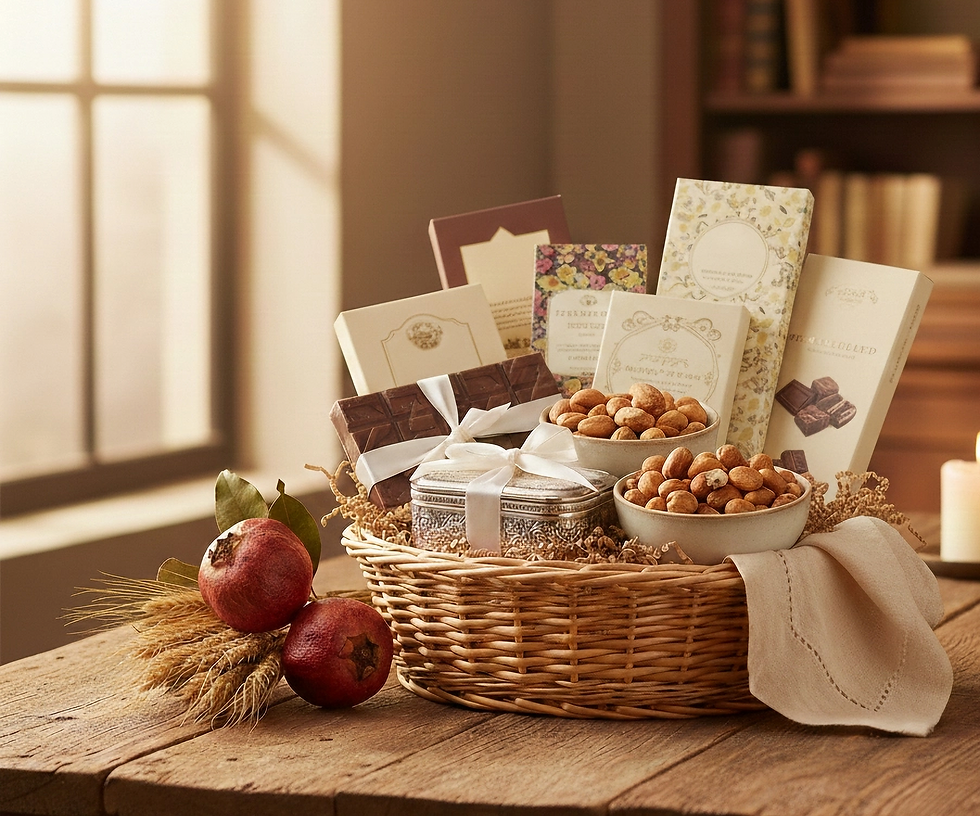
At a minimum, mishloach manot includes two different ready-to-eat food items. Beyond that basic requirement, customs vary widely.
Common items include:
Baked goods
Snacks or sweets
Fruit
Beverages such as wine or juice
Chocolate
Practical considerations often shape what people choose: foods that travel well, keep their quality, and are easy to share tend to be favored.
Why chocolate became so common in Mishloach Manot
Chocolate has become one of the most popular components of mishloach manot for simple, practical reasons.
It is:
Widely liked across ages
Easy to portion
Shelf-stable
Associated with joy and indulgence
Because mishloach manot are often prepared in large quantities and shared broadly, chocolate fits naturally into the custom without requiring explanation or special handling.
Practical kosher considerations during Purim
Purim celebrations typically include a festive meal, and many of these meals are meat-based. Because mishloach manot are often eaten around the same time they are received, the kosher status of foods can matter more than expected.
Dairy items may not be suitable to eat together with or immediately after a meat meal. This is why, in many contexts, foods that avoid such restrictions are preferred.
Where parve chocolate fits in
Parve foods (those containing neither meat nor dairy) can be eaten with both meat and dairy meals. For this reason, parve chocolate is often chosen for mishloach manot, especially when gifts are shared widely or eaten during the Purim meal.
It is important to note that parve status is not determined by appearance or ingredient claims alone (for a clear explanation of what parve means in chocolate production, see our guide on parve chocolate).
Likewise, products labeled vegan or dairy-free are not automatically parve (a distinction explored in more detail in our article on why vegan chocolate is not always parve).
Final takeaway
Mishloach manot is about more than food. It is a custom rooted in joy, generosity, and community, expressed through the simple act of sharing something ready to eat.
Understanding the meaning of the tradition, when it is observed, and how food choices fit into the Purim meal helps avoid confusion and ensures that gifts can be enjoyed by everyone. Chocolate has become a natural part of this custom, and when chosen thoughtfully, it supports the spirit of Purim.
If you are looking for a kosher giandujotto to include in your Mishloach Manot this Purim, ODELIA produces certified parve giandujotto in Torino, Italy, certified by CBMC (US), KF Kosher (UK), and Badatz Beit Yosef (Israel). Browse our kosher giandujotto collection for individual and bulk formats.
FAQ
What is the purpose of Mishloach Manot?
To increase joy, friendship, and unity by sharing food on Purim.
When is Mishloach Manot given?
During the daytime of Purim. Giving it at night does not fulfill the custom.
What must be included in Mishloach Manot?
At least two different ready-to-eat food items.
Why is chocolate so common in Mishloach Manot?
Because it is widely liked, easy to share, and fits naturally into festive food gifts.
Why does parve status matter during Purim?
Because many Purim meals include meat, and under kosher dietary law, meat and dairy cannot be served together, and parve foods (meaning they contain no dairy or meat ingredients and are produced on dedicated parve equipment) can be eaten without timing restrictions
For other Jewish holidays, see our guide on kosher chocolate for Passover.
Browse ODELIA's gift box collection for ready-made Mishloach Manot options.
Browse our kosher gift boxes — curated for Mishloach Manot and all Jewish holidays.
ODELIA's kosher giandujotti are certified by CBMC (USA), KF Kosher (UK), and Badatz Beit Yosef (Israel), making them a trusted Mishloach Manot choice across every community standard. To place an order or request documentation, contact us.


Comments